Simon Baker makes The Mentalist an agreeable crime programme, despite cases that seldom escape the familiar formula. We recommend it for his mischievous intelligence, with a caveat about deductions that arrive too easily and disagreements that recur too often.
Bruno Heller’s The Mentalist is a good crime programme built around a familiar pleasure: watching someone notice what everybody else has missed. Its chief advantage is Simon Baker, who makes Patrick Jane’s certainty entertaining for longer than the writing has any right to expect. We recommend it for that performance, with reservations about the ready-made cases and the bickering used to fill the gaps. Its ambitions sit comfortably within the case-solving formula.
The scepticism about psychic powers is a useful starting point. Patrick Jane’s abilities depend on observation and psychological manipulation, so there is something for us to understand behind the apparent mind-reading. We enjoyed the debunking more than we expected. Watching an apparently uncanny insight explained through close observation is satisfying, though the speed of the deductions can leave little for us to work out. The programme sometimes hurries past the very thing that makes its detective interesting.
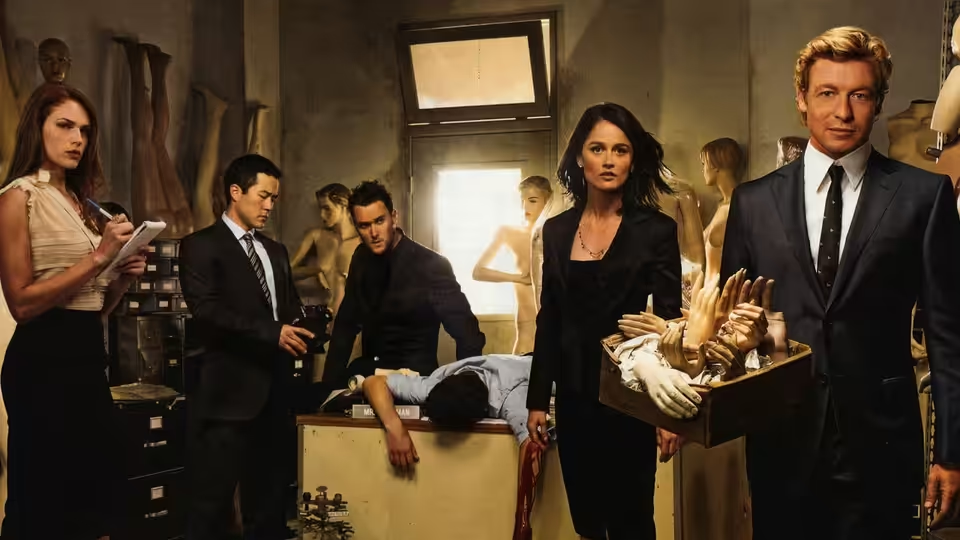
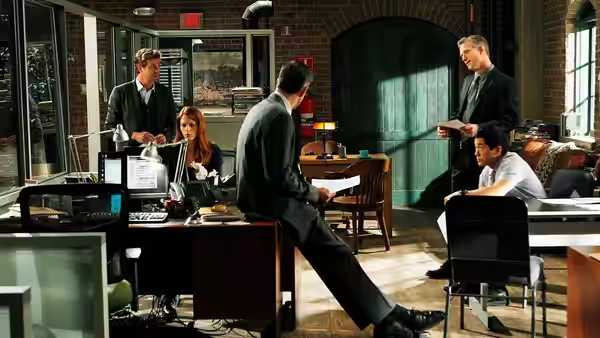
Simon Baker is doing more than making the solution sound clever. His charm lets Patrick Jane enjoy knowing more than everyone else without making every exchange feel like a reprimand. There is still smugness here, and viewers with a low tolerance for it will reach their limit sooner than we did. Robin Tunney’s Teresa Lisbon and Tim Kang’s Kimball Cho give him other people to play against, but recurring disagreements are a thin substitute for developing those relationships. The ensemble deserves more room than the formula readily grants it.
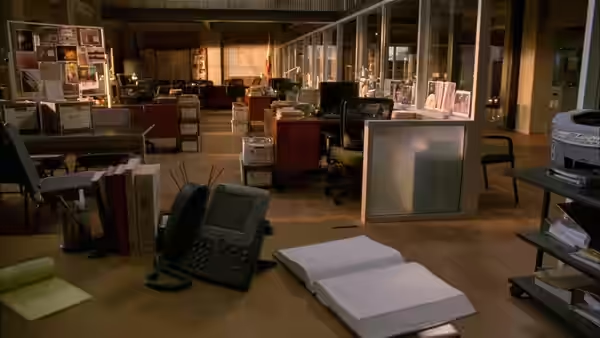
The polished presentation helps. Cinematographers including Frank Perl and Jeffrey Jur give the investigations a readable clarity, a sensible approach for a series dependent on noticing behaviour. The production design, credited to Michael Novotny and Julie Walker, is similarly unobtrusive: the settings seldom compete with the actors for our attention. That restraint works, although the combined effect can feel too tidy for stories concerned with violent crime.
The rhythm is less assured. Editors including Glenn Farr and Anthony Rivard have to balance the briskness of a puzzle with the interruptions of a quarrelling team, and those exchanges sometimes slow an investigation without adding much. Blake Neely’s music is more persuasive in the lighter passages than when the programme demands sudden gravity. Neither the cutting nor the score entirely smooths out those awkward changes of mood. The slower stretches expose how much depends on Patrick Jane being entertaining.
What keeps the series agreeable is its willingness to let intelligence be mischievous. Its low-tech approach gives Simon Baker’s performance a useful share of the work, and the pleasure comes from seeing what he makes of another person. That is enough to sustain an ordinary case when the writing gives him something worth noticing. It becomes less satisfying when superior observation simply allows the detective to skip the difficult part of an investigation, leaving the audience to accept his explanation afterwards.
A taste for puzzle-led crime is the deciding factor. The series treats murder chiefly as something to be solved, with little appetite for the untidiness that a more realistic treatment would require. That is a reasonable choice for this kind of programme, provided the people doing the solving remain agreeable company. Try an episode for Simon Baker; if Patrick Jane’s self-satisfaction already annoys you, there is no duty to persevere.