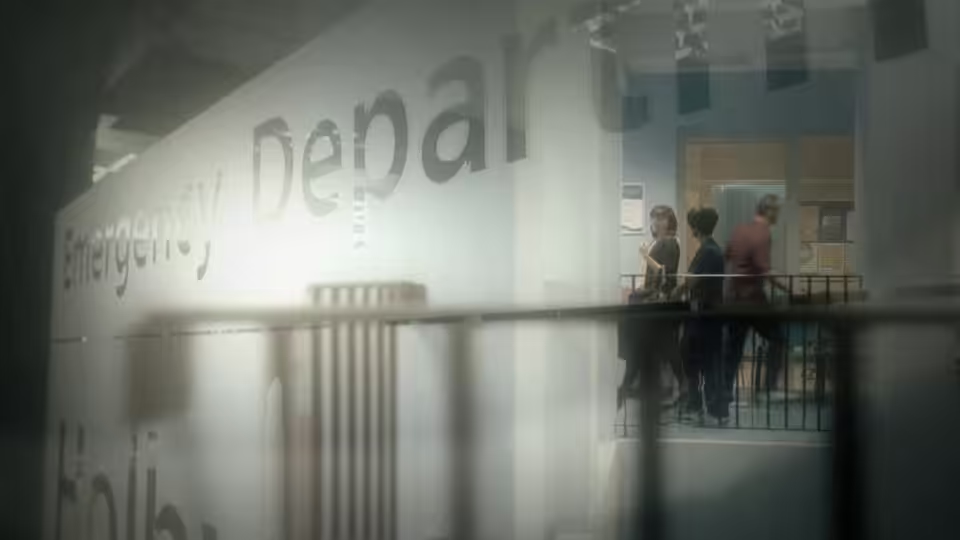
Forty years on, the engine has not changed: a stranger’s ordinary morning, a trolley through the doors, a nurse who has seen it before. Formulaic and often predictable, it is also more honest about an exhausted health service than most dramas made with ten times the care.
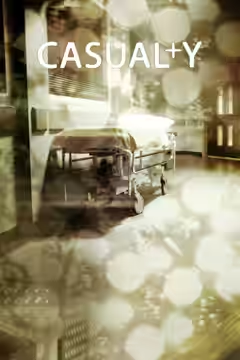
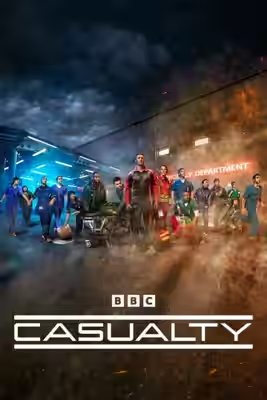
Jeremy Brock and Paul Unwin created Casualty as a night-shift drama about an A&E department its own hospital would rather not pay for, and the first series, fifteen episodes from 6 September 1986, is angrier than anything the programme has made since. It is still going, in its forty-sixth run as we write, and the verdict has not really moved in that time. It is dependable, it is formulaic, and on a Saturday night it is better company than it has any right to be. We would not tell a stranger to watch it. We would not stop anyone either.
The formula is the thing. Every episode opens away from the hospital, on people who do not know they are in a medical drama: a man on a roof, a child near a pond, a couple arguing in a car. We know what is coming and the programme knows we know, and it still works on us. We sat through a cold open about a decorator and a loose rung with our shoulders up by our ears, which is absurd, and then felt the small relief of the ambulance doors opening and the familiar faces taking over. That relief is what the series sells, and it has been selling it for four decades.
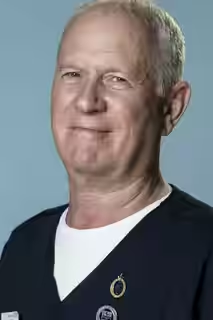
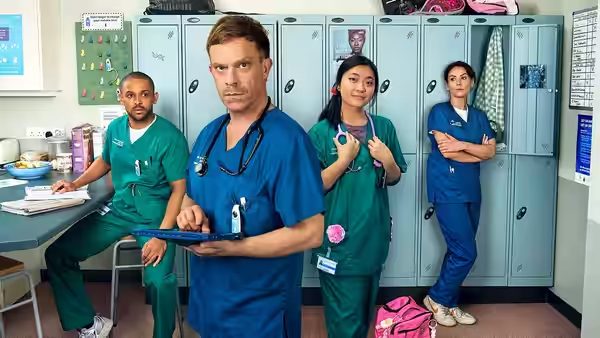
Derek Thompson’s Charlie Fairhead is the reason it holds. Thompson plays him as a man who has stopped expecting the shift to end and has made peace with it: no speeches, a lot of standing in doorways, a voice that gets quieter when things get worse. William Beck’s Dylan Keogh is the other long-serving spine, a consultant who is rude to everyone and right most of the time, and Beck lets you see what the rudeness costs him. Charles Venn’s Jacob Masters supplies the warmth the other two withhold. When the three of them share a corridor the programme looks like what it wants to be, a workplace rather than a soap.
The writing credits are a surprise if you have never looked. Richard Curtis, Ben Aaronovitch, Peter Bowker, Ashley Pharoah, Barbara Machin and Tony McHale have all written episodes; Antonia Bird, Hettie Macdonald, Euros Lyn and SJ Clarkson have all directed. The series has been a training ground, and the better episodes carry a writer’s fingerprint: a guest patient who is allowed to be funny, a nurse who gets to be wrong, a last scene that ends on a look rather than a line. The worse episodes could have been assembled from parts.
There are a great many of the worse ones, and that is a matter of arithmetic. Fifteen episodes a year became twenty-four by 1992 and forty-eight by 2004, and nothing survives forty-eight hours of television a year without repeating itself. The staff romances arrive on schedule. The disaster episodes, a coach, a fire, a flood, are staged with real nerve and then resolved with a hug in the staff room. A single-take episode a few years ago was treated by the reviews at the time as a stunt that squeezed the story, and from what we saw we would not argue. When the programme reaches for prestige it tends to drop what it was holding.
Since 2023 the series has been cut into named runs of twelve, Driving Force, Breaking Point, Storm Damage, Lethal Legacy, each with a theme and an arc, and the change suits it. A story about violence towards staff or a drug shortage has room to be about that thing for twelve weeks instead of one scene. The recent anniversary episodes drew warm notices, and the praise for Beck is deserved; he does more with a pause than most of the cast do with a monologue. Whether the format change counts as renewal or tidying we are not sure, but the episodes are shorter on filler than they were.
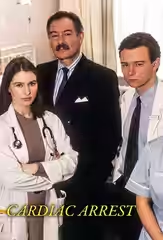
Set against ER or Cardiac Arrest it looks slow and soft. Set against the hospital dramas that have come and gone around it, it has one thing they lacked, which is that it never pretended the building was well run. The money is always short, the managers are always in the way, the staff always do it anyway. That was true in 1986 and the programme has not had to update it.
Start anywhere; it is built to be joined mid-shift. If you want it at its angriest, go back to the first fifteen and watch a department fight to stay open. If you want it at its most comfortable, pick a recent run, make a cup of tea, and do not look too hard at the ladder.