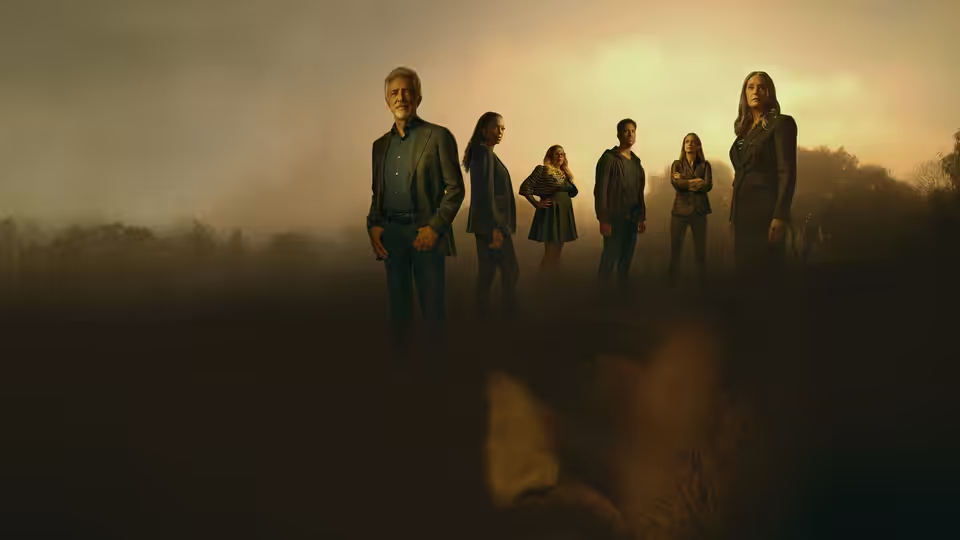
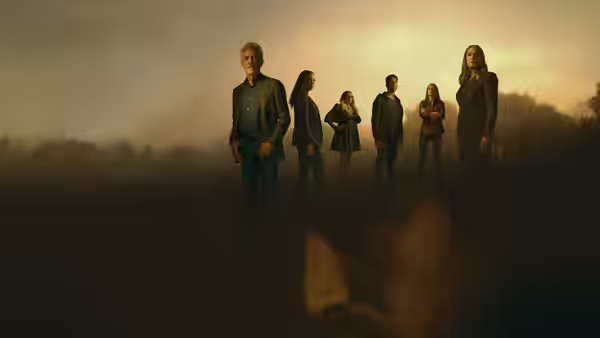
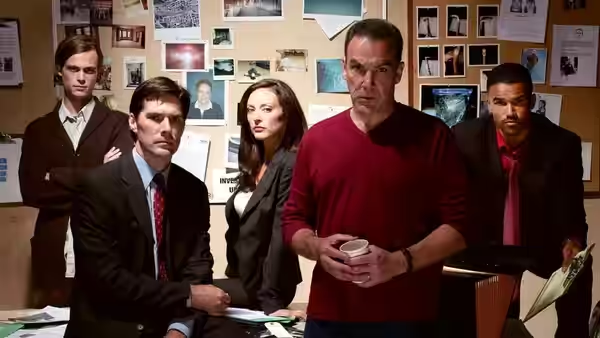
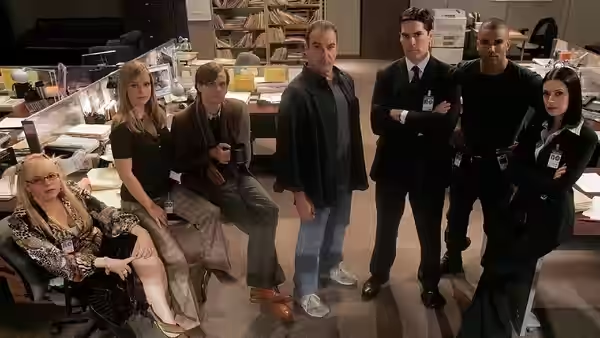
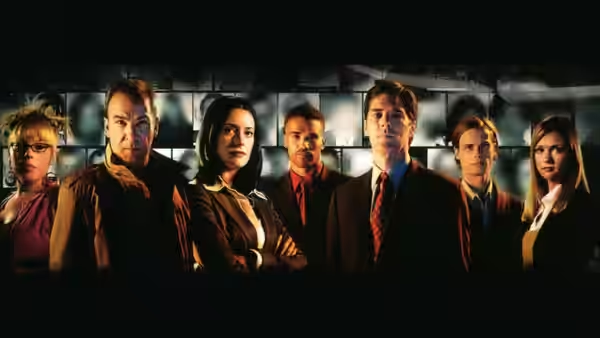
Jeff Davis’s procedural about FBI profilers is grim, efficient and nearly identical from one week to the next, and it has run for nineteen seasons on that promise. It is comforting television about horrible things, and we are not sure that is a compliment.
Jeff Davis created Criminal Minds in 2005 and it has outlasted almost everything that was on television beside it: nineteen seasons and 364 episodes since 22 September 2005. The pitch is the tagline. To catch a criminal, you have to think like one. A unit of FBI profilers flies to a town, studies what the killer has left behind and describes him to the local police until he turns into a person with an address. That is the whole of it, and the series has never wanted to be more.
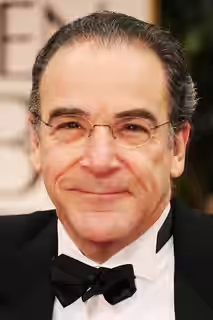
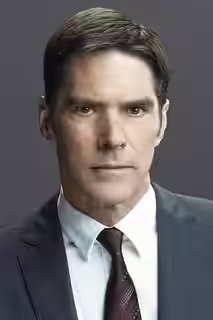
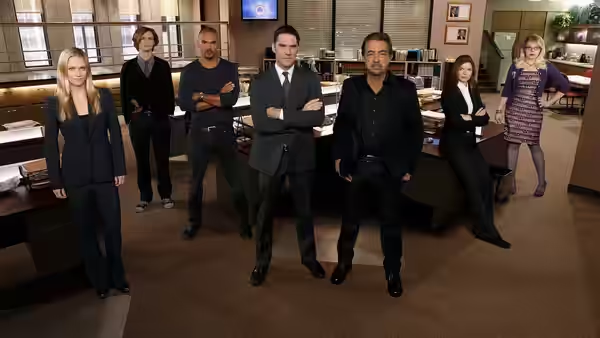
Mandy Patinkin’s Gideon is why the early episodes hold. He plays the profiler as a tired, courteous man who would rather be somewhere quieter, and who looks at a crime scene photograph the way other people look at a crossword. Thomas Gibson’s Hotchner is the opposite pole, a man so buttoned up he seems held together by the suit. Matthew Gray Gubler’s Reid does the exposition, statistics at speed, and Gubler makes a small running joke of the boy’s awareness that nobody asked. Kirsten Vangsness’s Garcia is the one person allowed any colour, in her clothes and her lines, and she works the case from Quantico while the others fly.
Greg St. Johns shoots it in two palettes. The offices and the jet, where people talk, are blue-grey and clean; the basements and motel rooms, where people are hurt, are brown and underlit. The cut from one to the other is the series’ basic move, and the editing, credited to Michael Schweitzer, makes it hundreds of times: a bound woman’s face, then a whiteboard. Vincent Jefferds’s round conference table and the jet’s pale leather seats are the sets you will remember. Marc Fantini and Steffan Fantini supply a string sting for the killer and a soft piano for the closing quotation.
The profiling is nonsense, and the series does not mind. A man is deduced from a knot in a rope to be white, between thirty and forty, recently sacked and cruel to animals as a boy, and he is, every time. What troubled us more was where the camera rests. The victims are mostly women, mostly young, and the series spends more of its time on their fear than on anything else, then calls it procedure. More than once we found ourselves uncomfortable in a way we do not think was intended: an episode would stay with a girl in a cage long enough that we stopped thinking about the case and started wondering who this was for. Then the jet would take off, the strings would come in, and everyone on screen felt better.
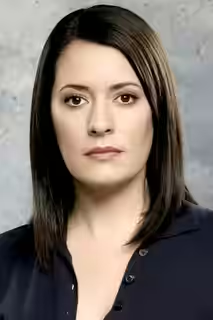
And yet. We watched four in a row one wet Sunday, could not afterwards tell you which had been which, and were not unhappy. That is what a formula this rigid buys you: nothing can hurt, because by the closing quotation the plane has landed. The cast turns over as long casts do. Joe Mantegna’s David Rossi arrives as an older profiler with a short fuse; Paget Brewster’s Emily Prentiss becomes the one we would most want on our side; Aisha Tyler’s Dr. Tara Lewis and Adam Rodríguez’s Luke Alvez come later still. Tyler, Rodríguez, Gibson, Cook, Mantegna and Gubler all end up directing episodes, and Vangsness writes some.
The last four seasons are a different animal: ten episodes each, from 24 November 2022, built as one serialised hunt rather than a case a week, with Zach Gilford’s Elias Voit, whose place in things we will leave you to find. It is darker, and the longer episodes suit it. A killer who lasts a season is worth more fear than one caught before the credits.
Against the genre’s own standard it sits mid-table. Cracker (1993) gave the profiler a gambling habit and let him be wrong; Mindhunter (2017) did the same job slowly and made it sad. Criminal Minds is the one you put on because it is on. Keep the sound a little low, keep something in your hands, and skip any episode that opens in a basement, which is more of them than you would think. It carries a 15 and earns it.