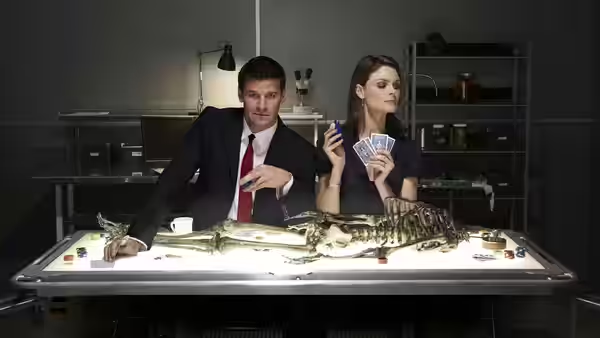
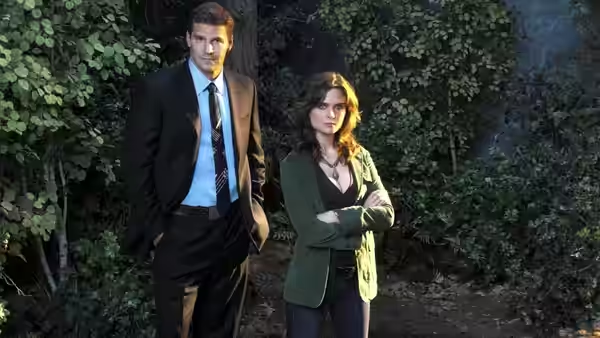
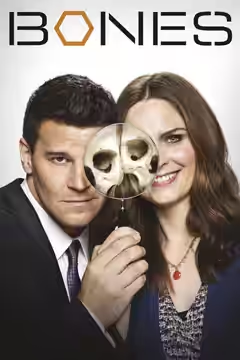
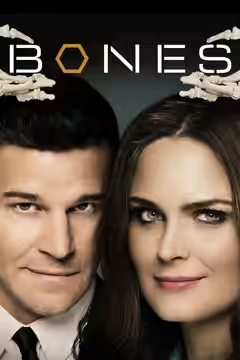
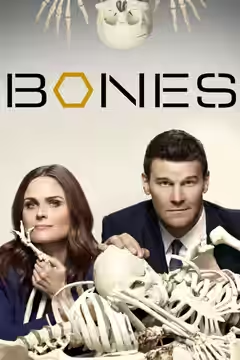
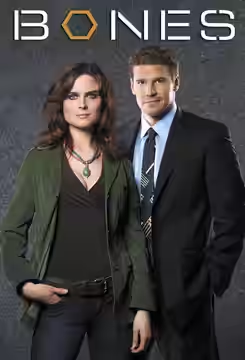
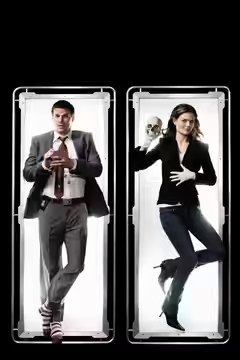
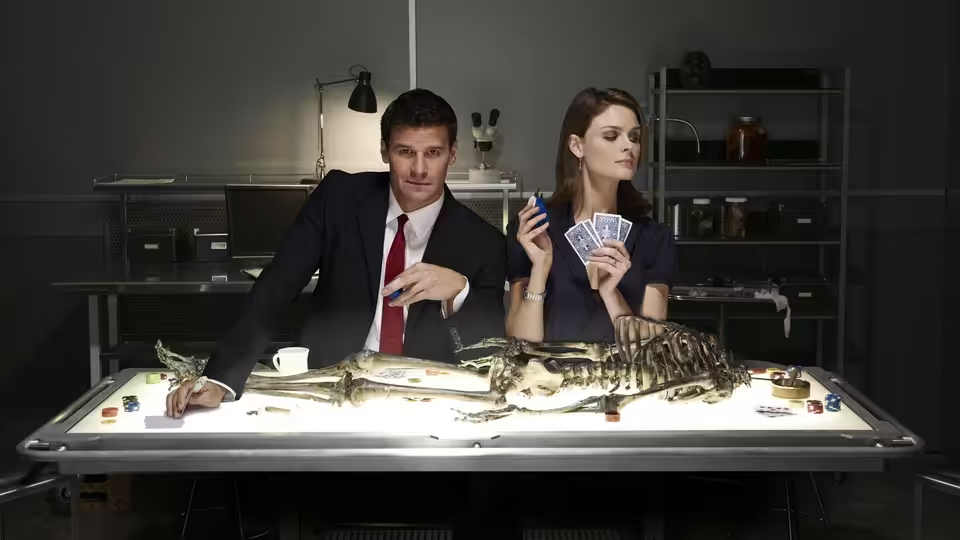
Booth (David Boreanaz) and Brennan (Emily Deschanel) examine a skeleton on a lab table
Series review

Bones

2005 · Created by Hart Hanson · Series

In a sentenceTwelve years of two people flirting over a corpse, and the corpse is usually the least implausible thing on the slab

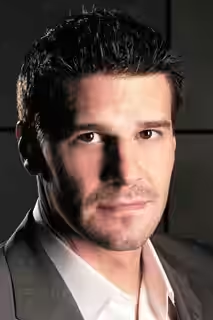
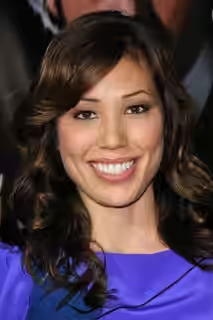
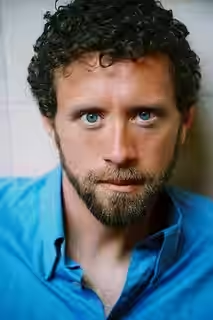
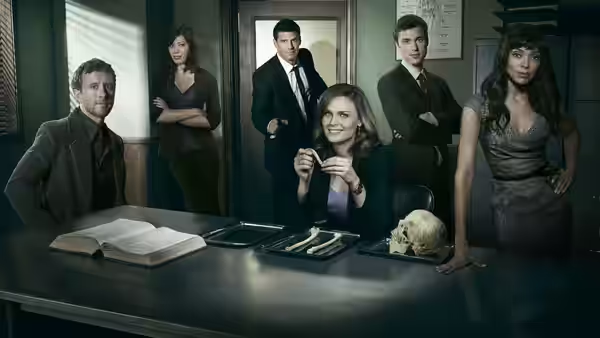
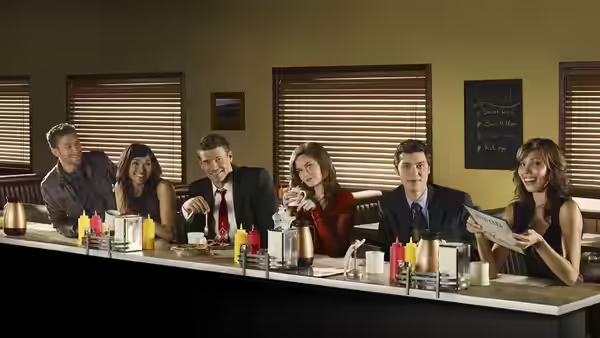
Washington DC. Temperance Brennan (Emily Deschanel) is a forensic anthropologist at the Jeffersonian Institute who can read a whole life from a skeleton and cannot read a face across a table. Seeley Booth (David Boreanaz) is the FBI agent who needs her to put names to remains the Bureau cannot identify, calls her Bones, and would rather not sit through her lectures while she works. In the lab are Angela Montenegro (Michaela Conlin), who gives the dead their faces back, and Jack Hodgins (T.J. Thyne), who handles the insects and the mud with more pleasure than is decent. Booth wants a suspect. Brennan wants what the bone says and will not guess. Each week a body arrives in a state nobody wanted to see.

Fi1m review

Hart Hanson’s forensic procedural runs on a decade of bickering between a scientist who does not understand people and a federal agent who does not understand science. The bodies are absurd and the cases forgettable; the pair carrying them are not.

Hart Hanson’s series has a simple engine: a woman who trusts only evidence, a man who trusts his gut, and a corpse between them every week. It ran for twelve seasons and 246 episodes between 2005 and 2017, which is longer than most marriages, and for most of it the show was better company than a programme about liquefied remains has any right to be. It is a good procedural rather than a great one, and the two people at the centre are the reason to watch and the reason it lasted.

Emily Deschanel plays Brennan as literal to the point of rudeness. She says she does not know what a phrase means and she means it; Deschanel never plays the line for cuteness. David Boreanaz plays Booth as a man who learned young how to be liked and is faintly embarrassed by how well it works. Their best scenes are in the car, where nobody has to look at anybody and both say more than they intended. The pilot pushes the banter too hard, and the first few episodes feel like two actors being told to spar; by mid-season they have found a rhythm and the writers have stopped shouting the premise.

The lab is the show’s second lead. T.J. Thyne’s Hodgins treats every jar of slime as a present and every government agency as a plot, and he made us laugh more than anyone else. Michaela Conlin’s Angela is the warmth, the one person in the building who asks how everyone is and waits for the answer. Tamara Taylor’s Camille Saroyan runs the place with the flat patience of someone who has read the budget. John Francis Daley’s Lance Sweets exists to be told by Brennan that psychology is not a science, and Daley takes it well. Jonathan Adams’s Daniel Goodman holds the early seasons together with a raised eyebrow. Ryan O’Neal drifts in as Max Keenan.

The production design, by Victoria Paul and those who followed her, gives the Jeffersonian a glass-and-steel atrium with a raised platform at its heart, lit cool and blue, so the dead are always on a stage. The cinematographers, Michael D. O’Shea and Gordon Lonsdale among them, shoot the bodies frankly: the camera does not cut away while Hodgins names the maggots. We were revolted, regularly, and the show intends it. A corpse comes out of a septic tank or a chimney, and the lab crowds round it as cheerfully as a family round a Sunday roast. Sean Callery’s score is sparing, mostly low strings under the quiet moments, and it knows when to stop.

The science is fantasy. A skull goes into a machine and a face comes out in seconds; a fragment of femur tells Brennan a man’s diet, hobby and postcode. The cases are the weakest part: the murderer tends to be the third person interviewed. The serial-killer arcs the show reaches for whenever it wants to feel serious are its poorest stretches; it is not built for dread. The later seasons lean harder on the lab family and softer on the crime, and the programme drifts towards a warm sitcom with a body in it.

What surprised us was being moved. The cause was small and recurred: Brennan is told something kind, answers it with a fact, and Deschanel lets us watch her realise, half a second too late, that she has got it wrong. The show is honest about how slowly people change, and it lets the pair change slowly, in ways we will not describe. Most crime series of its era kept the leads fixed and rotated the corpses. This one did it the other way round, which is why the reviews tend to talk about the romance and not the murders.

Start at the beginning, forgive the pilot, and watch two a night with someone who will argue with you about whether love is a chemical. Stop when you notice you have stopped caring who did it; by then the show will have been running for years and you will have stopped caring about that too. It carries a 15, chiefly for what comes out of the chimneys.
Critical consensus AI synthesised

3 of 6
Positive
2
Mixed
1
Negative
0
Vulture
28 March 2017
80*

The critic praises Bones as quietly spinning one of the most interesting love stories on TV despite its procedural format. They single out the evolving relationship and chemistry between Brennan and Booth as the standout element.

Read the full review →
The Guardian
10 January 2013
78*

The critic finds the forensic crime comedy series better than it needs to be, with charm in its writing, imagination, secondary characters and attention to detail despite its absurdity. They single out the memorable line from boss Cameron Saroyan as a highlight of the show's entertainment value.

Read the full review →
Variety
11 September 2005 · Brian Lowry
52*

The pilot mixes House and X-Files elements but feels forced in its banter and overly familiar visually, resulting in another standard crime procedural with a not-especially-fresh twist. The best element is the testy relationship between FBI agent Booth and the scientists he calls 'squints'.

Read the full review →

Straight answers AI written, from our review

Is Bones worth watching?
Bones is worth watching for anyone who wants a procedural carried by its two leads rather than its cases, and we scored it 70. Emily Deschanel and David Boreanaz are the reason it lasted twelve seasons; the murders are forgettable and the murderer is usually the third person interviewed. Forgive the pilot and give it half a season.
Where can I watch Bones in Saudi Arabia?
Bones is not on any streaming or rental service in Saudi Arabia at the moment. It is available in 55 other countries; change your country at the top of the page to see where. Availability is checked daily.
How violent or frightening is Bones, and is it suitable for children?
Bones carries a 15 in the UK, chiefly for the corpses, which arrive out of septic tanks and chimneys and are filmed frankly while the lab names the maggots. We were revolted regularly, and the show means it. It is not built for dread, so it is rarely frightening, but it is not for children or for anyone squeamish about what a body becomes.
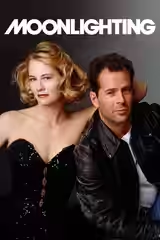
How does Bones compare to Moonlighting?
Bones is the slower, fonder descendant of Moonlighting, the original show about two people who should not work together and cannot stop. The earlier programme is faster and sillier, and prone to congratulating itself; the later one is steadier and gives its pair years to change. Go to Moonlighting for the quarrels, to Bones for the long haul.
What should I watch after Bones?
After Bones, try Moonlighting (1985, Fi1m 82): The original two-people-who-should-not-work-together show; faster, sillier, just as fond. Then The X-Files (1993, Fi1m 84): Sceptic and believer, another lab, another decade of not quite saying it; and The Bridge (2011, Fi1m 88): A detective who takes everything literally, paired with a man who does not; Denmark and Sweden.

Cast

If you liked this, try…

  1. Moonlighting (1985, Fi1m 82)The original two-people-who-should-not-work-together show; faster, sillier, just as fond.

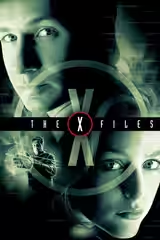
  2. The X-Files (1993, Fi1m 84)Sceptic and believer, another lab, another decade of not quite saying it.

  3. Silent Witness (1996) · not on Fi1m yetThe British forensic version: greyer skies, sadder pathologists, bodies treated with more solemnity.

  4. The Bridge (2011, Fi1m 88)A detective who takes everything literally, paired with a man who does not; Denmark and Sweden.

  5. Elementary (2012) · not on Fi1m yetAnother brilliant, difficult investigator kept honest by a partner who is better at people.